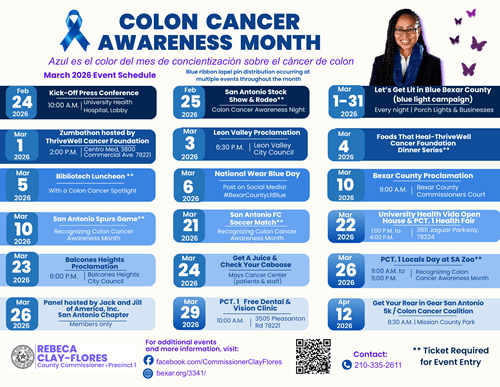
University Health and Bexar County Precinct 1 Commissioner Rebeca Clay-Flores kicked off Colon Cancer Awareness Month today with a press conference featuring a slew of activities including sporting events, health clinics and other ways to raise awareness.
Commissioner Clay-Flores was joined by physicians from the multidisciplinary team that treated her after she was diagnosed in late 2024, as well as several partners in the Colon Cancer Awareness Month initiative.
It was a shock for Clay-Flores to be diagnosed with a disease that did not run in her family. Now she is determined to educate the public about risk factors, symptoms and the importance of lifesaving screenings. Her office has organized Colon Cancer Awareness Month throughout March. National Wear Blue Day is March 6. Please post on social media #BexarCountyLitBlue. Commissioner Clay-Flores is also calling on businesses and residents to light up their buildings and homes with blue lights.
“Colon cancer is on the rise in younger people. It’s the second leading cause of deaths amongst cancers and is now the leading cause of cancer deaths in people under 50,” Commissioner Clay-Flores said.
“But it is also slow-growing and one of the most preventable forms of cancer when detected early,” she said. “Getting a preventative colonoscopy at 45 can save your life.”
What causes colon cancer in younger people?
The increase has been so significant and sustained that in 2021 the recommended age to begin routine colorectal cancer screening was officially lowered from 50 to 45.
The precise cause for the increase isn’t clear, said University Health Chief of Gastroenterology Dr. Sandeep Patel, but the disease is linked to many environmental and lifestyle risk factors that are also on the rise.
“We’re eating a lot more processed food and red meat,” he said. “Our sleep hygiene has changed.” Stress has increased, as well as obesity. Alcohol and tobacco use are factors.
Colon cancer symptoms
Symptoms can be vague and often attributed to other illnesses, making it more difficult to recognize when a screening is called for. They include:
- Bloody stool
- Changes in bowel habits that last more than a few days
- Diarrhea or constipation that doesn’t resolve quickly or recurs
- Fatigue
- Iron-deficiency anemia
- Persistent bloating or a feeling of abdominal fullness
- Stools in a thinner shape than usual
- Weight loss with no known cause
Catching it early
The good news is that there’s more screening available that can help people stop cancer in its tracks. Not only has the lowering of the recommended screening age made colonoscopies more available, but a primary care provider can also offer other, less invasive screening tests like fecal immunochemical (FIT) and stool DNA tests.
If those tests detect abnormalities, a colonoscopy is recommended. The colonoscopy is the most effective method with the added advantage that pre-cancerous polyps and early cancers can be detected and removed or treated immediately, improving survival and reducing deaths.
“It’s safe, it’s easy and there’s nothing to be nervous about,” Dr. Patel said.
If a person is 45 or older and has not been screened or has symptoms or a family history of colon cancer, they can contact their primary care provider to begin this important and potentially lifesaving screening.
Events calendars are attached, with a clip of Commissioner Clay-Flores, and images from the press conference for news use. For more information, visit our page.