Serving the world from the heart of San Antonio's West Side
Hundreds turned out Friday to learn more about treatment, prevention and research on World Diabetes Day at the Texas Diabetes Institute in the heart of San Antonio’s West Side
Community members were able to get free glucose and blood pressure testing, easy fitness training and fall prevention education, and the first 150 received an HEB voucher for a free turkey for the Thanksgiving table.
“Pick a card,” Texas Diabetes Institute Fitness Center Manager Irene Lopez told participants. They would cautiously pull a card from the deck she had spread on a table. “Spade! That’s chest muscles, raise your elbows like this and squeeze them together … Heart! That’s a modified jumping jack (minus the jumps) – put your hands above your head and swing them up and down.”
Each exercise was simple, designed for anyone, and could be modified for seated participants. Those who entered cautiously found themselves moving to the dance playlist and laughing at the fun.
“The concept is that anybody can move,” Lopez said, and any movement, if it is regular, is good.
Diabetes rates are increasing globally, but in the U.S., Texas is one of the states with the highest rate. In Texas, diabetes tops the national average with 3.2 million adults who have it, and another 245,000 a year are diagnosed. That is 13% of the adult population that have diagnosed diabetes.
In Bexar County, make that 15%, and it’s concentrated on the West, South and East sides of San Antonio.
That’s why University Health built the Texas Diabetes Institute in Zip Code 78207, a creating a global research leader serving our community and the world.
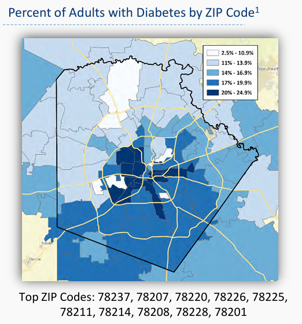
“More than 15 percent of the population in the San Antonio area have diabetes,” said Dr. Renata Belfort, endocrinologist and director of research at Texas Diabetes Institute and an associate professor at UT Health San Antonio. There are several reasons it’s most concentrated in certain parts of the city, she said.
“We know that diabetes is associated with some risk factors,” Dr. Belfort said. “It could be genetic … it could be food insecurity, access to food that is not so healthy, maybe walkability around the neighborhood.”
“It is a big problem, it is associated with several complications and it has a high mortality rate. It’s the fifth cause of death in the United States.”
Our teams addressed this not only by testing blood sugar to help identify who is at risk, they discussed all aspects of diabetes care with the visitors and patients. University Health’s limb salvage and podiatry teams shared information on reducing the risk of amputations, diabetes research teams provided information about studies that support patient health, our CareLink team provided Medicare information and more.
“We know the prevalence of diabetes is high but there is also a very high prevalence of people who don’t know they have diabetes,” Dr. Belfort said. “Talk with your doctor and have your glucose level or hemoglobin A1C tested.”
The need is greater than ever, with an estimated 830 million people worldwide living with diabetes. Learn more about research, treatment and prevention.
Related Stories
Director of Research at University Health shares factors to why Bexar County has high diabetes rate - KENS5