
When you think about ways your child can get hurt, poisoning may not be the first thing that comes to mind, but maybe it should be. According to Safe Kids Worldwide, poisoning is the third leading cause of unintentional injury death in children.
That’s at least in part because of kids’ natural curiosity. To a toddler, for example, the world is full of exciting shapes, colors and objects to explore. Some of those brightly colored bottles hold tasty things, like juice or milk. But not everything in a colorful bottle is safe to drink.
“Many household cleaners and chemicals are packaged in bright colors that can look similar to sports drinks or juice,” said Elizabeth Davila, program manager at Safe Kids San Antonio. “Young children don’t yet understand warning labels, so it’s easy for them to confuse a cleaning product with something safe to drink. That’s why safe storage and supervision are so important.”
That’s why it’s critical to be proactive and childproof in your home against poisons.
Common Places Children Find Household Poisons
You may have heard that as part of childproofing your home, you should get down on the floor at a kid’s level to see from their perspective. That same strategy can work well when looking to poison-proof your home.
Take a close look around your house, both inside and out, looking for these common items that poison children at home:
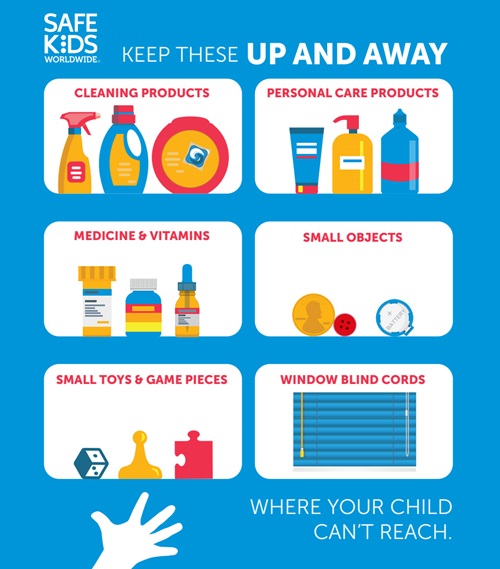
- Bathroom or laundry room: Pine oil, drain and toilet cleaners, bleach, disinfectants, detergents, detergent pods and aerosol sprays
- Bedrooms: Cosmetics, cologne, hair spray, nail polish and remover, mothballs, medications and vitamins
- Garage: Antifreeze, windshield cleaner, gasoline, charcoal lighter, pesticides, fertilizers, garden chemicals, fungicides and flea and pest powder
- Home workshop: Solder, lead, cadmium, formaldehyde, solvents, paint and paint thinner
- Kitchen: Insect killer, metal polish, alcohol, dishwashing detergent and oven cleaner
While these are among the most common poisonous substances in the home, the list isn’t all-inclusive. Look in all areas of your house and property, searching for items that could catch a child’s attention.
Child Safety Tips for Poisoning Prevention
No parent ever wants firsthand experience with poisoning. Take these steps to make your house safer for kids at every age and stage:
Infants (0-12 mo)
When your little ones are tiny, the key is to keep nearly everything out of their grasp. That means storing medications, chemicals and other potential poisons several feet off the floor.
Because laundry and dishwashing detergent pods can be mistaken for candy and make easy targets for kids, you may want to switch to powder or liquid detergent.
Toddlers (1-3 yrs)
When kids get on their feet and start moving, poison-proofing becomes a little more challenging. In addition to the tips above, here are some other basics for poison-proofing your house for toddlers.
Install automatic-locking safety latches on cabinets throughout your home, including those containing cleaners, detergents and personal care items. Avoid leaving anything on a countertop or other surface because toddlers can (and will) climb. They move fast, too, so don’t leave those items even for a moment.
When doing crafts or other activities that use glue or other potential poisons, never leave your toddler unattended.
Preschool (3-5 yrs)
As kids get older, they’re likely to push their limits. Remember that childproof packaging isn’t always childproof, so be sure to store items out of sight and reach.
Medication Safety
This is also a good age to begin emphasizing the difference between medication and food. “You should never call medicine ‘candy’ because it can create confusion and increase the risk of accidental poisoning,” said Davila. “Young children think very literally.”
It’s better to:
- Call medicine what it is, medicine
- Explain that it is only given by a trusted adult
- Store it up and away, out of sight and reach
Clear language helps children understand that medicine is something to be taken safely, not a snack or reward.
Keep Products in Original Packaging
Davila also wants to emphasize that while it may be tempting to transfer cleaning supplies into decorative containers for a more organized or aesthetically pleasing look, it’s safest to keep all products in their original packaging.
“Original containers are designed with child-resistant closures and include important hazard warnings and first-aid instructions,” said Davila. “Transferring products into unmarked or easier-to-open containers increases the risk of accidental poisoning and can delay emergency treatment if the original label information isn’t readily available.”
What to Do If Your Child Ingests a Poison
If you think a child has swallowed something they shouldn’t have, take the following steps:
- Remain calm. This will let you make good decisions. It will also show your child that you are in control of the situation and that things will be OK.
- Call 911, your local emergency number or the U.S. Poison Control Center at 800-222-1222. Davila encourages families to save Poison Control in their phone contacts.
- Read the label of the swallowed product to the health care provider.
- Follow the health care provider’s instructions exactly. Don’t make your child throw up since vomiting can cause further damage. This is especially true if the child has swallowed lye, dishwashing detergent, drain cleaner or paint thinner.
While vomiting isn’t advised, the American Academy of Pediatrics recommends having your child spit out any remaining substance in the mouth. This can help limit how much of the chemical enters the body.
Sharing Prevention Tips
Many poisonings occur in secondary homes where medications may be stored in pill organizers or other easily accessible containers.
Medication and poison safety should be a priority everywhere your child spends time, not just in your own home. Make sure grandparents, babysitters, relatives and other caregivers store medicines and household chemicals up and out of reach.
Partnering to Protect Kids’ Health
University Health is the lead partner of Safe Kids San Antonio. We work alongside this advocacy group to teach parents and other caregivers in our community how to safely care for children.
Learn more about our partnership with Safe Kids and other services that can be accessed through our Injury Prevention Programs.
Pediatric Trauma Care at University Health
University Health is the only Level I pediatric trauma center in South Texas. This designation means we provide the highest level of pediatric trauma care in the region.
When every second counts, our experienced trauma team moves quickly to begin life-saving care. Board-certified pediatric specialists are on standby to treat children with the most critical injuries.